Section 80C Investments: Which Option is Best for You?
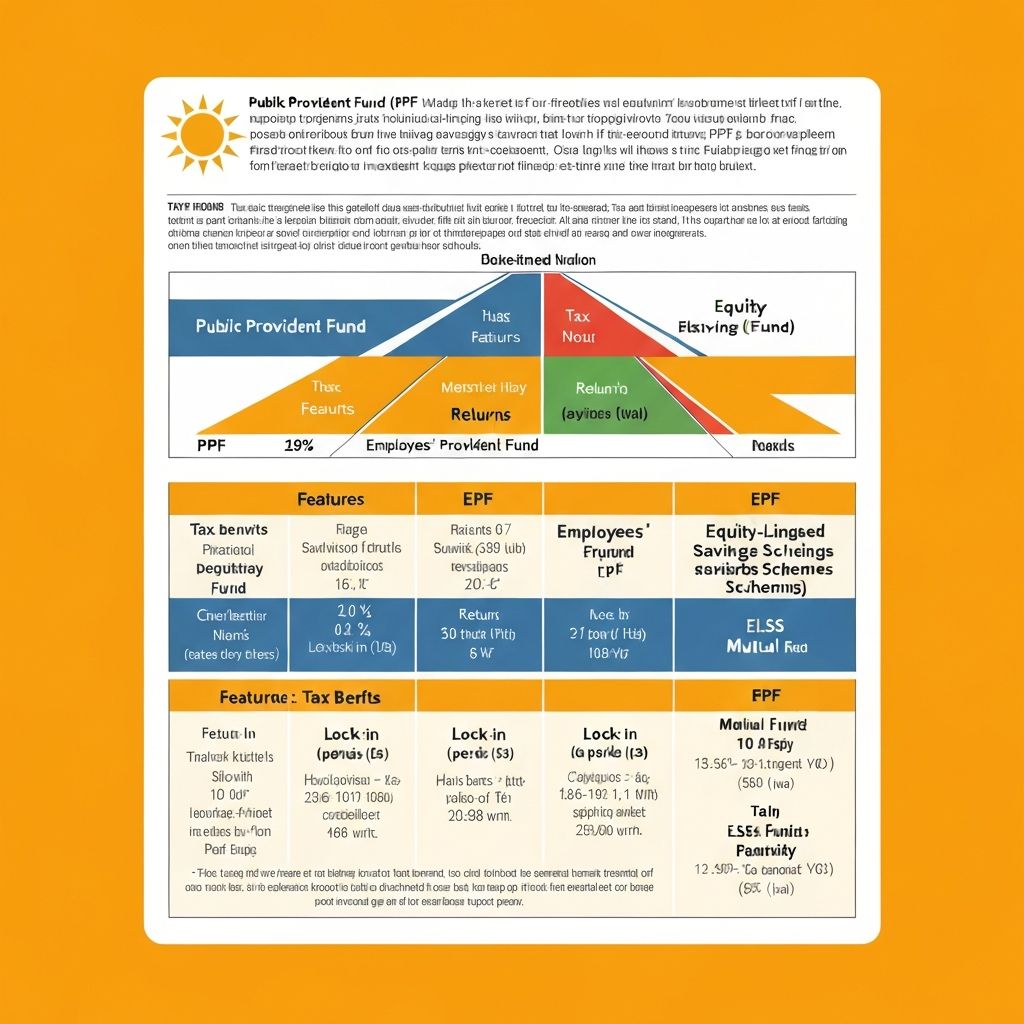
Section 80C allows you to save up to ₹1.5 lakh in taxes annually. But with so many options available, which one should you choose? Let's compare all major 80C investments.
Complete List of 80C Investments
Investment Options:
1. Public Provident Fund (PPF)
**Lock-in:** 15 years
**Interest Rate:** 7.1% p.a. (compounded annually, tax-free)
**Contribution:** Minimum ₹500, Maximum ₹1.5 lakh per year
Best for:
Pros:
Cons:
2. Equity Linked Savings Scheme (ELSS)
**Lock-in:** 3 years (shortest among 80C options)
**Returns:** 12-15% p.a. (market-linked, not guaranteed)
**Investment:** Minimum ₹500, no upper limit
Best for:
Pros:
Cons:
**Recommendation:** Best option for investors under 35 with 5+ year horizon
3. National Savings Certificate (NSC)
**Lock-in:** 5 years
**Interest Rate:** 7.7% p.a. (compounded annually)
**Investment:** Minimum ₹1,000, no maximum limit
Best for:
Pros:
Cons:
4. Tax-Saving Fixed Deposits
**Lock-in:** 5 years
**Interest Rate:** 6-7% p.a. (varies by bank)
**Investment:** Minimum varies (₹100-₹1,000), Maximum ₹1.5 lakh for 80C
Best for:
Pros:
Cons:
5. Employee Provident Fund (EPF)
**Lock-in:** Till retirement (partial withdrawal allowed)
**Interest Rate:** 8.25% p.a. (tax-free)
**Contribution:** 12% of basic salary (employee + employer)
Best for:
Pros:
Cons:
**Pro Tip:** Maximize EPF through Voluntary Provident Fund (VPF) for extra tax-free returns
6. Sukanya Samriddhi Yojana (SSY)
**Lock-in:** Till daughter turns 21 (or marriage after 18)
**Interest Rate:** 8.2% p.a. (highest among all schemes, tax-free)
**Contribution:** Minimum ₹250, Maximum ₹1.5 lakh per year
Best for:
Pros:
Cons:
7. Life Insurance Premium
**Lock-in:** Policy term (varies)
**Returns:** Varies by policy type
Best for:
Pros:
Cons:
**Recommendation:** Buy term insurance separately (not for 80C). Use ELSS/PPF for tax saving
8. NPS (National Pension Scheme)
**Lock-in:** Till 60 years
**Returns:** 8-12% p.a. (market-linked)
**Additional Benefit:** Extra ₹50,000 deduction under 80CCD(1B) over and above ₹1.5L
Best for:
Pros:
Cons:
Comparison Table
| Option | Returns | Risk | Lock-in | Liquidity | Best For |
|--------|---------|------|---------|-----------|----------|
| PPF | 7.1% | Zero | 15 yrs | Low | Long-term, Safe |
| ELSS | 12-15% | High | 3 yrs | Medium | Wealth Creation |
| NSC | 7.7% | Zero | 5 yrs | None | Fixed Income |
| FD | 6-7% | Zero | 5 yrs | None | Ultra Safe |
| EPF | 8.25% | Zero | Till 60 | Low | Retirement |
| SSY | 8.2% | Zero | 21 yrs | None | Girl Child |
| NPS | 8-12% | Medium | Till 60 | Very Low | Retirement |
Recommended 80C Portfolio Strategy
Age 25-35:
Age 35-45:
Age 45-55:
Age 55+:
Common Mistakes to Avoid
**Over-investing in life insurance:** Don't buy high-premium policies just for 80C. Buy term insurance separately and use ELSS/PPF for tax saving
**Putting all money in one option:** Diversify across 2-3 options
**Ignoring returns:** Don't choose tax-saving FD if you can tolerate moderate risk - ELSS gives better returns
**Not starting early:** The earlier you start, the more you benefit from compounding
**Forgetting about lock-in:** Understand liquidity needs before investing
My Recommendation
For most young professionals, **ELSS + PPF combination** works best:
This gives you:
**Need personalized advice?** Every financial situation is unique. I can help you choose the optimal 80C investment mix based on your age, income, risk appetite, and financial goals.
Contact me today for customized tax-saving investment planning!
Found this helpful? Share it with others!
Need personalized tax advice?
Every situation is unique. Let's discuss your specific case and find the best tax-saving strategies for you.
Chat on WhatsApp